

Soil does not behave the same way at every moisture level. A fine-grained soil that feels firm when relatively dry can become moldable as water is added and eventually behave almost like a liquid when its moisture content becomes sufficiently high. Understanding these changes is essential in geotechnical engineering because variations in soil consistency can influence strength, compressibility, workability, settlement, and overall construction performance.
The Atterberg limits test provides a standardized way to describe these moisture-dependent changes in fine-grained soils. Rather than simply measuring how much water a soil contains, the test identifies critical moisture-content boundaries associated with changes in soil consistency. The resulting liquid limit, plastic limit, and plasticity index can help engineers characterize soils and make better-informed decisions during site investigation and construction.
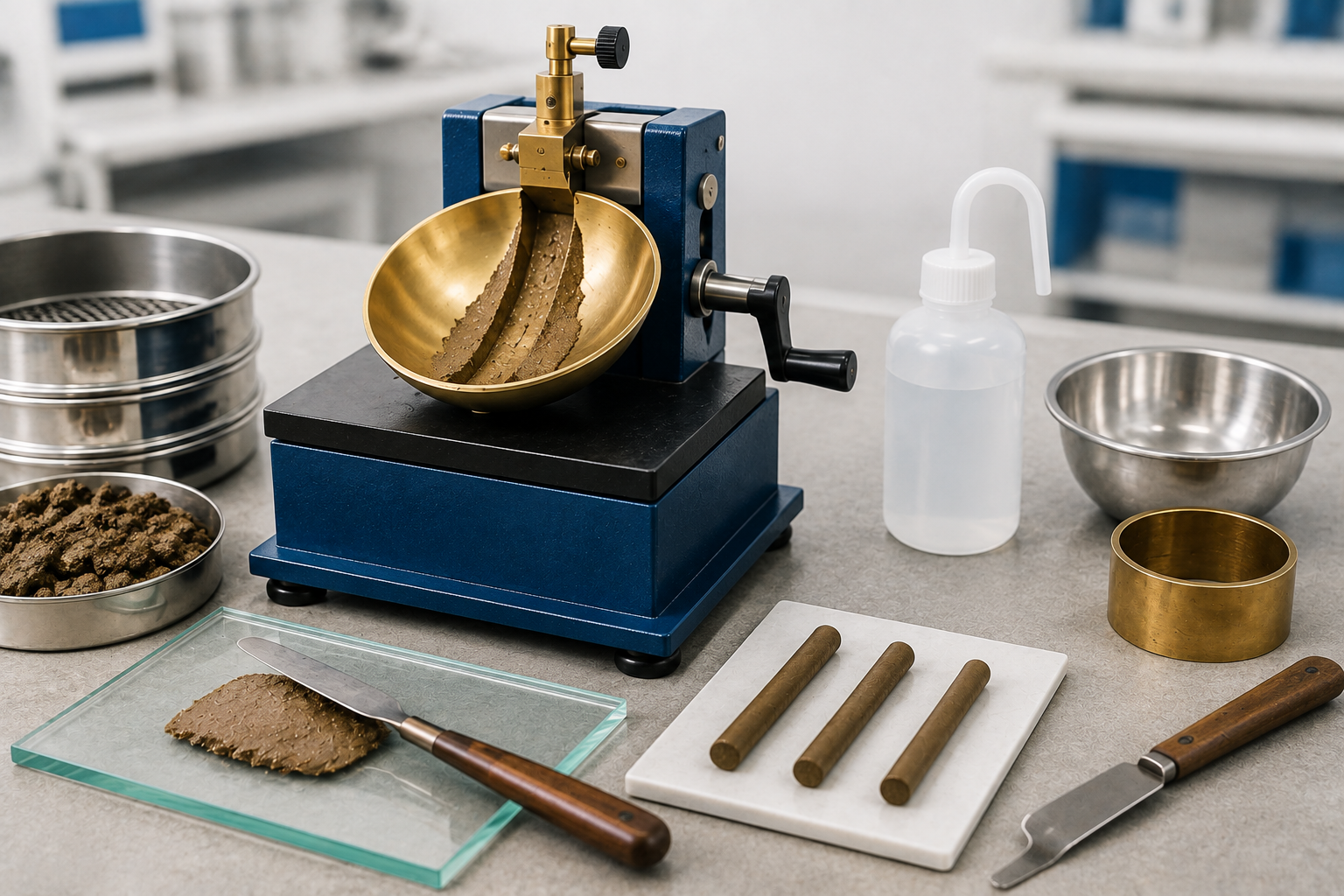
For laboratories performing geotechnical testing, having the right Atterberg limits test equipment is equally important. Certified Material Testing Products offers a range of liquid-limit machines, plastic-limit accessories, grooving tools, test sieves, and related laboratory equipment designed for soil testing applications.
What Is the Atterberg Limits Test?
The Atterberg limits test determines specific moisture contents at which a fine-grained soil changes from one consistency state to another. The concept is particularly useful for soils containing significant amounts of clay and silt because their engineering behavior can change considerably as moisture increases or decreases.
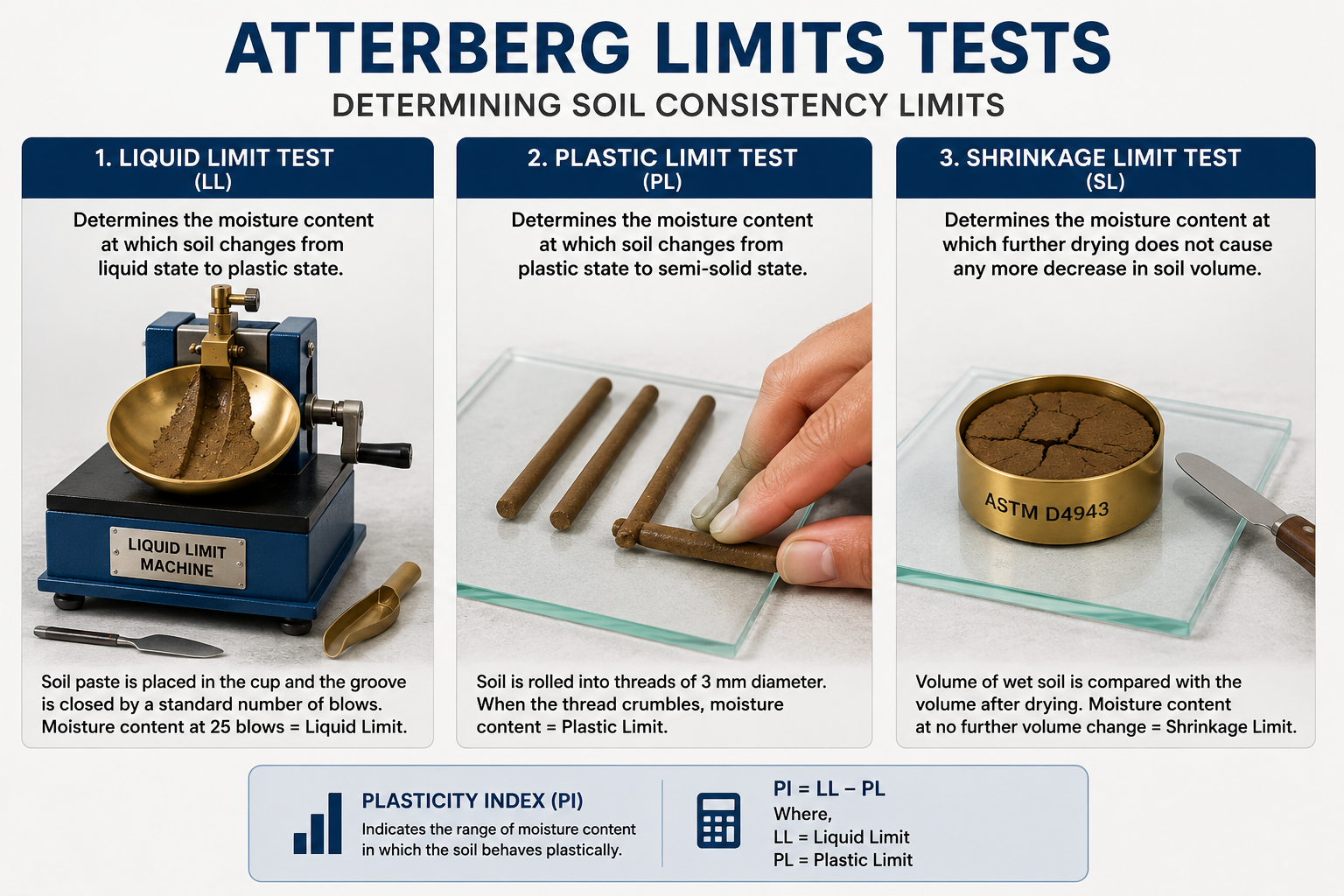
The principal limits are the liquid limit (LL), plastic limit (PL), and shrinkage limit (SL). The liquid and plastic limits are commonly used together to calculate the plasticity index (PI).
ASTM D4318 covers standard test methods for determining the liquid limit, plastic limit, and plasticity index of soils.
Certified MTP provides a dedicated Atterberg Limits Test Equipment collection for laboratories performing these soil tests.
Why Soil Plasticity Matters
Plasticity describes the ability of a soil to deform without cracking or breaking over a particular range of moisture contents. This property is especially significant when working with cohesive soils.
A highly plastic clay may undergo considerable changes in volume as its moisture content changes. It can become soft and compressible when wet and hard or brittle when dry. A soil with lower plasticity may experience less pronounced changes.
These characteristics can affect construction projects in several ways. Foundation soils may experience changes in volume, embankments can respond differently to rainfall and drying, and subgrade materials can lose desirable engineering properties when their moisture condition changes.
The Atterberg limits do not provide a complete description of soil behavior, but they provide useful indicators that can be combined with other tests to develop a broader understanding of the material.
The Four Soil Consistency States
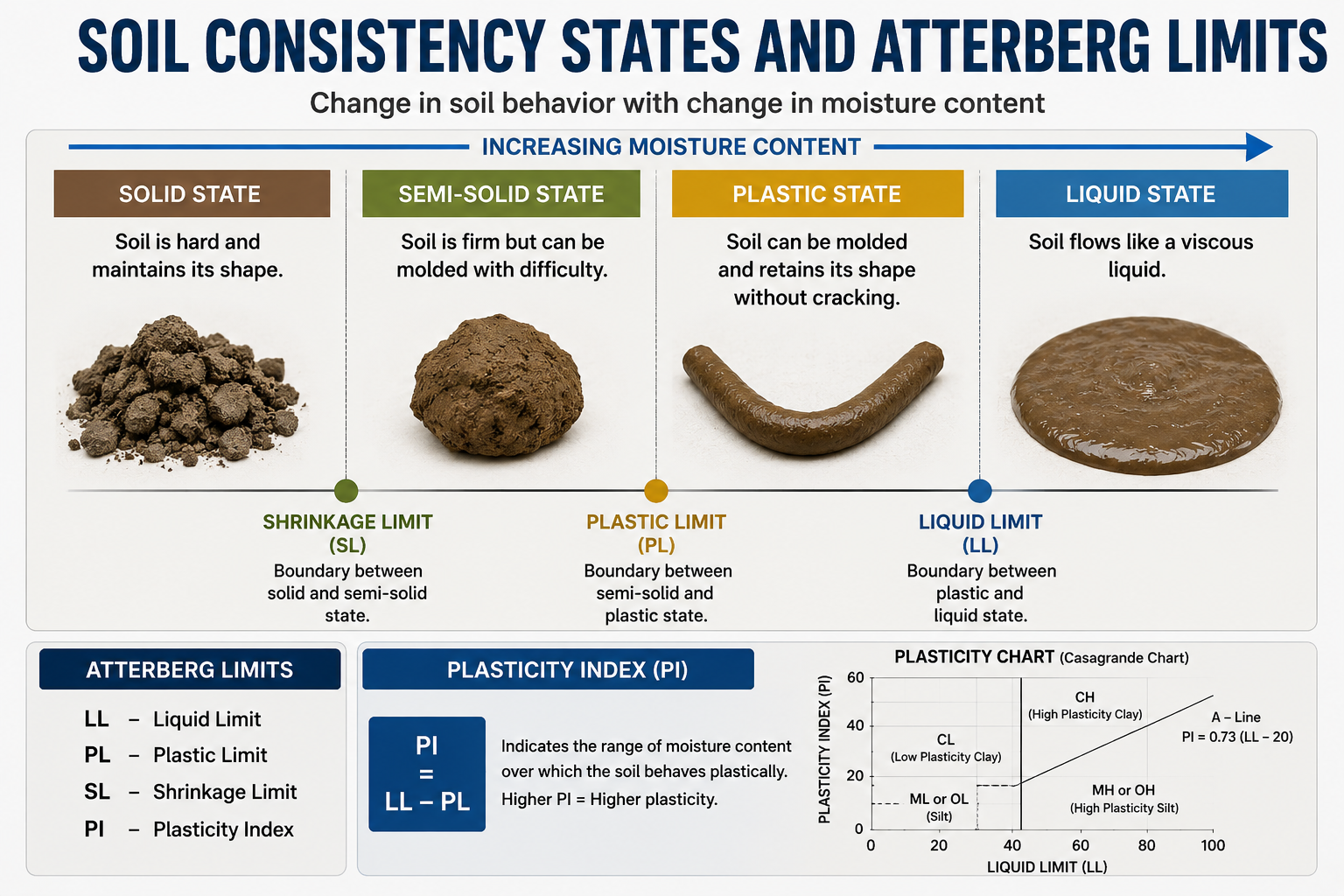
As water content changes, fine-grained soil can pass through four general consistency states:
Solid: At very low moisture contents, the soil behaves as a relatively hard solid.
Semi-solid: As moisture increases, the soil remains relatively stiff but can exhibit changes in volume and consistency.
Plastic: With additional moisture, the soil becomes moldable and can be deformed without immediately breaking apart.
Liquid: At sufficiently high moisture content, the soil loses its ability to maintain its shape and begins to behave like a viscous liquid.
The boundaries between these states are described using the Atterberg limits. Understanding this progression helps engineers connect laboratory measurements with how soil may behave under changing field conditions.
Liquid Limit: The Upper Boundary of Plasticity
The liquid limit is the moisture content corresponding to the transition between the liquid and plastic states under the conditions defined by the applicable test method.
In the traditional Casagrande method, a prepared soil sample is placed in a liquid-limit cup and divided using an appropriate grooving tool. The cup is repeatedly dropped from a controlled height, and the number of blows required for the groove to close over the specified distance is recorded.
The relationship between moisture content and the number of blows is then used to determine the liquid limit.
Certified MTP’s Hand-Operated Liquid Limit Machine provides a manual option for this type of testing. The company also offers a Hand-Operated Liquid Limit Machine with Counter designed for controlled cup drops and counting during the test.
For laboratories conducting frequent testing, selecting equipment that provides consistent drop height and stable operation can help reduce unnecessary variability.
Plastic Limit: The Lower Boundary of Plasticity
The plastic limit identifies the moisture content at which a soil changes from a plastic state toward a semi-solid state.
The traditional test involves working a portion of prepared soil into a thread on a non-porous surface. The sample is repeatedly rolled and remolded. As moisture is lost, the soil becomes less plastic. The plastic limit is determined when the soil thread reaches the specified diameter and begins to crumble according to the applicable procedure.
The plastic limit is important because it provides the lower boundary of the soil’s plastic range. When considered together with the liquid limit, it provides a much more useful indication of the soil’s plasticity.
Certified MTP offers a Liquid Limit / Plastic Limit Test Accessory Set containing laboratory accessories such as a glass plate, sample containers, stainless-steel pan, spatula, evaporating dish, and wash bottle. The listed set is intended for ASTM D4318, AASHTO T89, and AASHTO T90 applications.
What Is the Plasticity Index?
The plasticity index (PI) describes the range of water contents over which a soil behaves plastically.
The basic relationship is:
PI = LL − PL
where:
- PI = Plasticity Index
- LL = Liquid Limit
- PL = Plastic Limit
For example, if a soil has a liquid limit of 48% and a plastic limit of 24%, its plasticity index is 24 percentage points.
The PI is useful because it combines two separate measurements into a single indicator of the soil’s plastic range. Generally, a larger PI indicates a broader range of moisture contents over which the soil can behave plastically.
However, PI should not be interpreted in isolation. Engineers should consider it alongside particle-size distribution, natural moisture content, density, mineralogy, strength, and other relevant geotechnical properties.
What Is the Shrinkage Limit?
The shrinkage limit represents another important boundary in the behavior of fine-grained soil. It is associated with the moisture content below which additional drying does not produce a corresponding reduction in the soil’s volume.
This is particularly relevant when evaluating soils that can experience substantial volume changes during wetting and drying cycles.
Shrinkage behavior can be important for foundations, earthworks, pavements, and other structures where changes in soil volume may contribute to movement or settlement.
Certified MTP also provides Shrinkage Limit Test Equipment as part of its broader range of soil-testing products.
How the Atterberg Limits Test Is Performed
The exact procedure should always follow the applicable testing standard, but an Atterberg limited laboratory workflow generally involves several important stages.
1. Prepare a Representative Soil Sample
A representative sample is selected and prepared for testing. Sample preparation is important because large particles or inconsistent preparation can affect the reliability of the results.
For many Atterberg limits procedures, the fine-grained portion of the soil is prepared using a No. 40 sieve with an opening of approximately 425 micrometers.
Certified MTP offers ASTM Test Sieves for laboratory sample preparation and particle-size testing.
2. Prepare the Soil at the Required Moisture Condition
Water is incorporated into the prepared soil sample to create a workable paste. Different moisture contents may be evaluated during liquid-limit testing so that the relationship between water content and test response can be established.
Consistent mixing is important because uneven moisture distribution can affect test results.
3. Perform the Liquid Limit Test
For the Casagrande method, the prepared soil is placed into the cup of the liquid-limit machine. A standardized groove is created using the appropriate grooving tool.
The cup is then repeatedly dropped, and the number of blows required to produce the specified groove closure is recorded.
Certified MTP offers ASTM Plastic Grooving Tools designed for use with liquid-limit machines and identified as meeting ASTM D4318 requirements.
4. Perform the Plastic Limit Test
A portion of the prepared soil is rolled into threads on a suitable surface. The material is repeatedly rolled and remolded until it reaches the specified condition at which the thread begins to crumble.
The corresponding moisture content is used to determine the plastic limit.
5. Calculate and Interpret the Results
The liquid and plastic limit values can be used to calculate the plasticity index. Engineers can then interpret these results alongside other laboratory and field data.
The objective is not simply to obtain a number. The objective is to understand what that number says about the soil’s likely behavior under the conditions relevant to the project.
Equipment Needed for Atterberg Limits Testing
A properly equipped laboratory needs several pieces of soil testing equipment to perform reliable Atterberg limits testing.
Common equipment includes:
- Liquid-limit machine
- Casagrande cup
- ASTM-compliant grooving tools
- Plastic-limit testing accessories
- Glass plate or suitable rolling surface
- Spatula
- Sample containers
- Balance
- Drying oven
- No. 40 test sieve
- Moisture-content equipment
- Shrinkage-limit equipment when required
Certified MTP’s Atterberg Limits Test Equipment category brings together equipment for liquid-limit, plastic-limit, and shrinkage-limit testing. The category identifies ASTM D4318 as the standard method for liquid and plastic limits.
Manual vs. Motorized Liquid Limit Machines
Laboratories should consider testing volume and workflow when choosing a liquid-limit machine.
A hand-operated liquid limit machine can be a practical choice for laboratories performing occasional or moderate amounts of testing. It allows the technician to control the operation manually while keeping the equipment relatively straightforward.
A motorized liquid limit machine can be advantageous for laboratories performing frequent testing. Automated operation can help provide consistent cup movement and reduce repetitive manual work.
Certified MTP offers both hand-operated and motorized options, allowing laboratories to select equipment according to their testing requirements and workflow.
How Atterberg Limits Help With Soil Classification
One of the most important uses of the Atterberg limits is helping engineers classify fine-grained soils.
The liquid limit and plasticity index can be plotted on a plasticity chart and considered alongside particle-size information. This allows engineers to distinguish between different groups of fine-grained soils and develop a clearer understanding of their likely engineering characteristics.
For example, two soils may contain similar proportions of fine particles but behave differently because their plasticity characteristics are different.
Atterberg limits are therefore often used alongside particle-size analysis and other classification information rather than as a standalone measurement.
Certified MTP also offers Soil Classification Testing Equipment for laboratories performing broader soil characterization.
Why Atterberg Limits Matter in Construction
The value of the Atterberg limits test becomes particularly clear when considering what happens to soil in the field.
Foundations
Fine-grained soils beneath foundations can respond to changes in moisture. Understanding plasticity and shrinkage characteristics can help engineers evaluate whether soil may experience significant changes in behavior or volume.
Roads and Pavements
Subgrade materials are exposed to changing moisture conditions. Soil with undesirable plasticity characteristics may create challenges for pavement performance, particularly when combined with poor drainage or repeated wetting and drying.
Embankments
Earth embankments require materials with suitable engineering characteristics. Atterberg limits can provide useful information about the consistency and plasticity of fine-grained components.
Earthworks
During excavation, placement, and compaction, soil moisture can significantly affect workability. Understanding plasticity helps engineers and contractors anticipate how fine-grained materials may respond to moisture changes.
Factors That Can Affect Test Results
Accurate soil plasticity testing requires attention to sample preparation and laboratory technique.
Sample Preparation
Inconsistent preparation can produce inconsistent results. The sample should be prepared according to the applicable standard and testing requirements.
Moisture Distribution
Water needs to be distributed uniformly throughout the sample. A sample containing wet and dry areas may not represent a consistent test condition.
Equipment Condition
Liquid-limit machines should be inspected to ensure that the cup, base, carriage, and drop mechanism operate correctly. Grooving tools should also be appropriate for the selected method.
Operator Technique
Manual testing requires consistency. Differences in sample preparation, groove formation, rolling technique, or equipment operation can introduce variability.
Environmental Conditions
Temperature, evaporation, and laboratory conditions can influence moisture content during testing. Appropriate controls and timely measurements help improve repeatability.
Choosing the Right Atterberg Limits Test Equipment
Selecting Atterberg limits equipment should begin with the test methods your laboratory needs to perform.
If your primary requirement is liquid-limit testing, a suitable Casagrande-style machine and compliant grooving tools may be sufficient. If your laboratory also performs plastic-limit and shrinkage-limit testing, a broader equipment setup will be necessary.
Consider the following when selecting equipment:
- Applicable ASTM or AASHTO standards
- Manual or motorized operation
- Testing frequency
- Required accessories
- Sample preparation requirements
- Available laboratory space
- Ease of cleaning
- Replacement components
- Operator workflow
- Required measurement consistency
Certified MTP’s range includes liquid-limit machines, grooving tools, plastic-limit accessories, sieves, and other soil-testing products, making it possible to build a testing setup around the specific requirements of a laboratory.
Atterberg Limits Are One Part of a Larger Soil Testing Program
Although the Atterberg limits test provides valuable information about soil plasticity, it should not be treated as a complete assessment of soil performance.
A comprehensive geotechnical investigation may also include moisture-content testing, particle-size analysis, compaction testing, specific gravity, permeability, CBR, triaxial testing, or other procedures depending on the project.
For example, Atterberg limits can describe how fine-grained soil responds to moisture, while compaction testing can help evaluate the relationship between moisture content and dry density. Strength tests can provide additional information about how the material performs under applied loads.
Certified MTP’s Soil Testing Equipment range covers many of these laboratory and field-testing applications.
Final Thoughts
The Atterberg limits test is a fundamental tool for understanding how fine-grained soils respond to changes in moisture. By determining the liquid limit, plastic limit, shrinkage limit, and plasticity index where applicable, engineers can develop a clearer picture of soil consistency and plasticity.
These measurements can support soil classification and help inform decisions involving foundations, pavements, embankments, earthworks, and other construction applications. However, Atterberg limits are most valuable when interpreted alongside other soil properties and project-specific information.
For laboratories, reliable results begin with appropriate Atterberg limits test equipment, consistent sample preparation, careful testing technique, and adherence to the applicable standard. Certified MTP provides a range of Atterberg Limits Test Equipment, including liquid-limit machines, plastic-limit accessories, grooving tools, and related soil-testing products.
By combining dependable equipment with standardized procedures, laboratories can generate more consistent soil-plasticity data and provide engineers with information that supports better construction and geotechnical decisions.


