

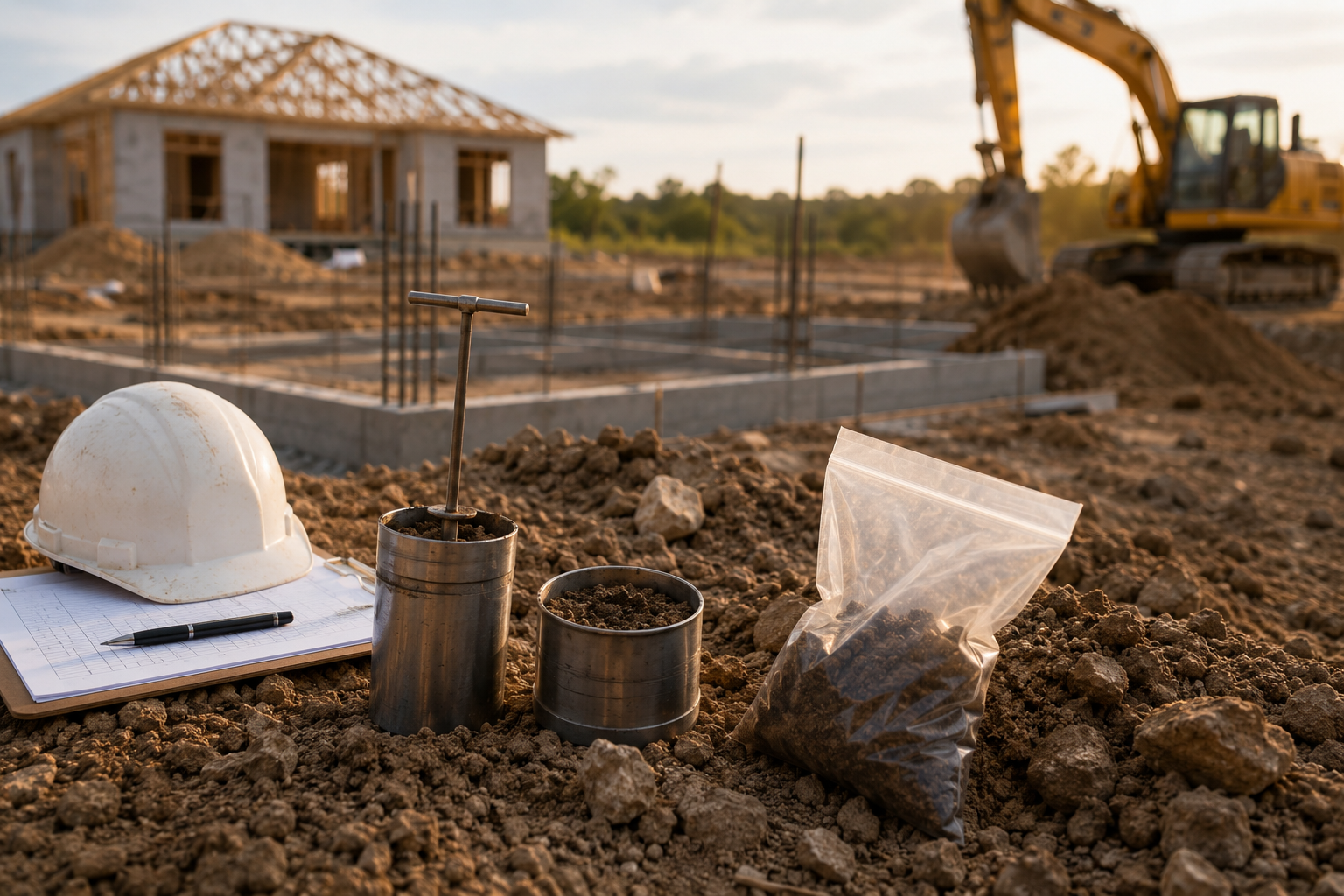
Most homeowners and developers spend months planning a construction project, reviewing blueprints, gathering permits, and sourcing materials. But one of the most consequential steps often gets skipped entirely: testing the ground beneath the structure. Whether you’re building a family home, a commercial space, or even a backyard addition, the soil under your foundation isn’t just dirt. It’s an engineering variable that can determine whether your building stands strong for decades or begins to sink, crack, and shift within years.
Soil behaves differently depending on its composition, moisture content, and load-bearing capacity. Ignoring these variables doesn’t make them go away, it just pushes the consequences down the road, usually at a much higher cost.
What Exactly Does Soil Testing Measure?
Soil testing, or geotechnical investigation, involves a range of field and laboratory analyses designed to characterize the physical and chemical properties of the ground. A professional evaluation typically examines:
- Bearing capacity – how much load the soil can support without failing
- Compaction levels – how densely packed the soil particles are
- Moisture content – the proportion of water in the soil, which affects strength and compressibility
- Atterberg limits – the boundary conditions at which soil transitions between liquid, plastic, and solid states
- Permeability – how quickly water drains through the soil, critical for drainage system design
These assessments aren’t reserved for massive infrastructure projects. Even modest residential builds require this data to choose the right foundation type, whether that’s a slab, crawl space, or full basement. Engineers use soil moisture testing equipment and other field-grade instruments to gather this data accurately and efficiently.
The Real Cost of Skipping Ground Analysis
It’s tempting to view soil testing as an optional line item, especially when budgets are tight. But the math rarely works out in favor of skipping it. Foundation failures are among the most expensive construction defects to repair. Depending on the extent of the damage, costs can run into tens of thousands of dollars, and in some cases, the structure must be demolished entirely.
Clay-heavy soils, for instance, expand significantly when wet and contract when dry. If a foundation is laid without accounting for this, seasonal moisture changes can cause dramatic movement, cracking walls, misaligning doors and windows, and compromising structural integrity over time. Similarly, loose or fill soil may compress under the weight of a new building, leading to uneven settling.
A thorough ground assessment before breaking ground is far cheaper than any remediation effort after construction is complete. Most geotechnical reports cost between $500 and $3,000 depending on site complexity, a fraction of what foundation repair typically demands.
What Types of Soil Present the Biggest Challenges?
Not all soil problems look the same. Some of the most commonly problematic soil types include:
- Expansive clay soils – highly reactive to moisture, common in the southern and western United States
- Organic soils or peat – highly compressible and poor load-bearing, often found near wetlands
- Loose sand or silt – prone to liquefaction during seismic events
- Fill material – previously disturbed earth that may be unevenly compacted and unpredictable
Knowing which type of soil you’re dealing with determines everything from the depth and style of your foundation to the type of drainage system your site needs. Remediation strategies, such as soil stabilization, deep piering, or grade beam foundations, can only be properly specified once the ground conditions are clearly understood.
How Testing Connects to Concrete and Structural Work
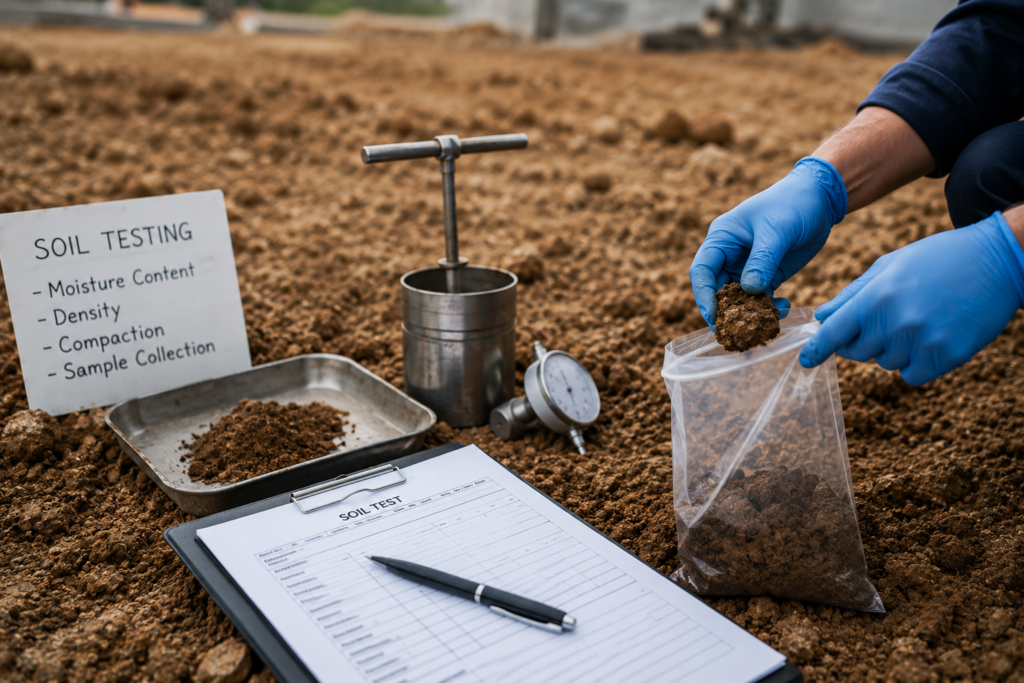 Soil testing doesn’t exist in isolation. The data gathered directly informs the concrete and structural specifications for the project. A soft or high-moisture subgrade, for example, might require a thicker concrete slab with additional reinforcement to prevent cracking under load. Conversely, well-compacted, granular soil could allow for a more economical foundation design.
This is why geotechnical engineers and structural engineers typically work in close coordination during the design phase. The properties of the soil dictate the demands placed on the concrete above it, and those demands must be verified through rigorous concrete testing before and during construction to ensure everything performs as designed.
Field tests like the slump test, air entrainment measurements, and compressive strength evaluations on concrete cylinders all play a role in verifying that the concrete mix will perform adequately given the specific site conditions revealed by soil analysis. When soil and concrete testing are treated as an integrated process rather than isolated checkboxes, the result is a structure built on verified data rather than assumptions.
When Should Soil Testing Happen?
Ideally, soil investigation should begin during the site selection phase, before you’ve committed to purchasing land. Knowing the ground conditions in advance can help you negotiate a better price, avoid sites with significant remediation costs, or plan your budget more accurately from day one.
At a minimum, testing should occur before any design work is finalized. Engineers cannot properly size foundations, select materials, or estimate costs without soil data. Starting construction without this information is essentially designing blind.
For phased construction or large developments, periodic re-testing may be necessary as different sections of the site are developed, particularly if the terrain changes significantly across the property.
A Note for Homeowners and DIY Builders
If you’re a homeowner overseeing a renovation or smaller construction project, soil testing might feel like it belongs to the realm of large-scale developers. But that assumption can be costly. Even a modest home addition requires a proper foundation, and that foundation’s adequacy depends directly on what’s underneath it.
Many municipalities now require a geotechnical report before issuing building permits for new construction. Where it isn’t required, it’s still strongly advisable. Think of it this way: you wouldn’t build a house without knowing the dimensions of the lot. Why build a foundation without knowing the properties of what’s beneath it?
Final Thoughts
Construction is an exercise in managing risk, and the ground beneath your building is one of the largest variables in that equation. Soil testing isn’t a bureaucratic formality, it’s the diagnostic step that makes everything else possible. When you understand what you’re building on, you can design intelligently, specify accurately, and build confidently.
From moisture probes and compaction testing in the field to lab analysis of soil samples, the tools and techniques available today make thorough ground assessment more accessible than ever. Skipping this step to save time or money almost always produces the opposite result and by then, the foundation has already been poured.


