

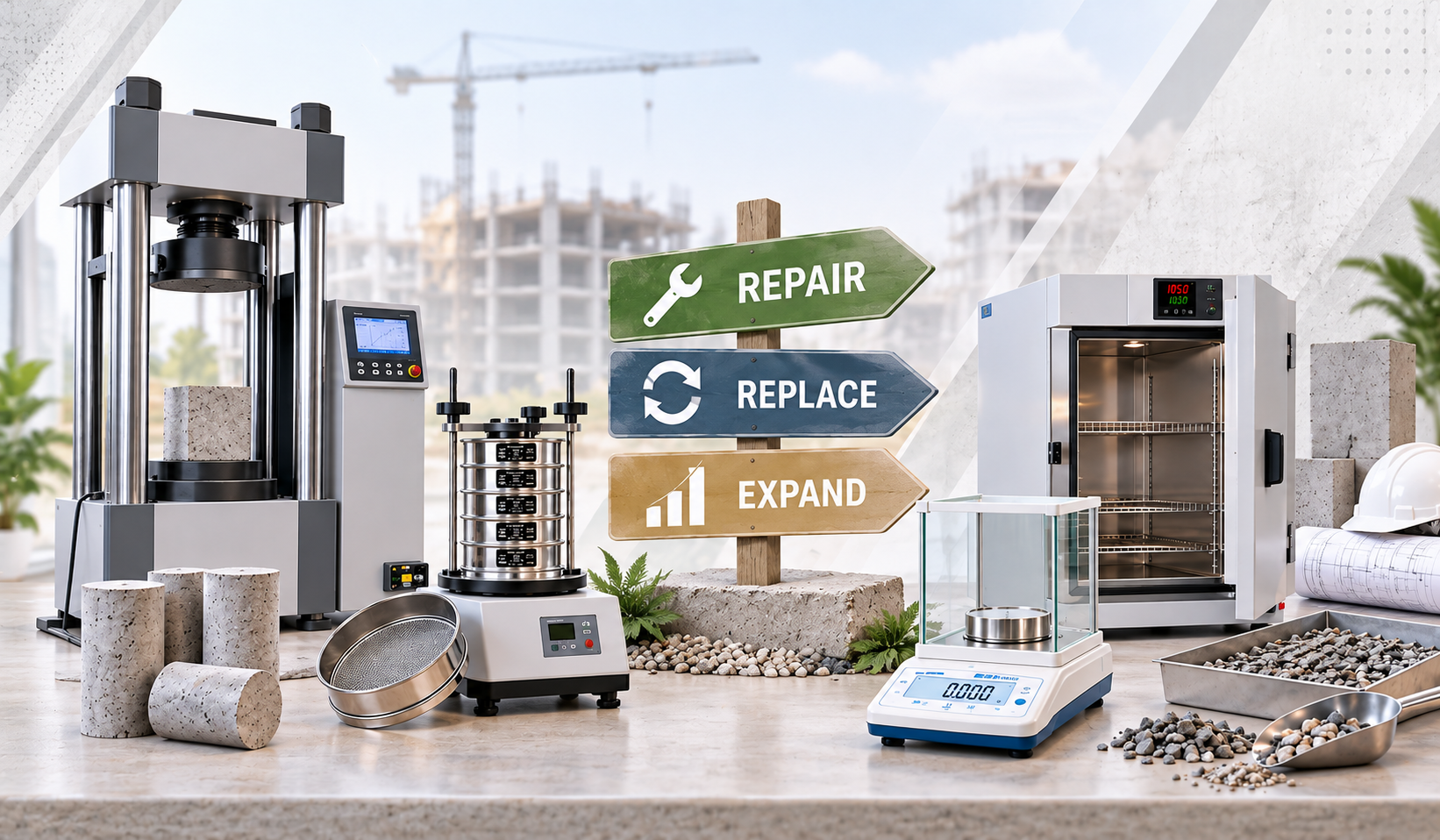
Equipment decisions in a construction materials testing lab almost never happen at a convenient moment. A compression machine starts throwing out inconsistent readings mid-program, a sieve shaker turns into the thing everyone’s waiting on, or an oven takes forever to come back up to temperature during a busy stretch.
The instinct is often to just buy something new. That’s not always the right call. Plenty of equipment can be repaired and put back into reliable service. Other units really do need to be replaced before they cause a quality problem or blow a deadline. And in a lab that’s simply grown, the issue might not be condition at all — it might be that there isn’t enough equipment to go around.
What follows is a framework contractors, engineers, and lab managers can use to work through that decision with evidence rather than gut instinct and time pressure.
Start With Testing Demand, Not Equipment Age
Age by itself doesn’t tell you much. A machine that’s been well maintained for fifteen years can still be perfectly stable and suited to the test methods it’s running. A brand-new unit, on the other hand, can be the wrong choice if it doesn’t have the capacity, range, fixtures, or data output the lab actually needs.
Go through the workload area by area — concrete, soil, aggregate, asphalt, general lab work — and for each major asset, look at:
- Average and peak test volume
- How hard it’s being used during busy periods
- Unplanned downtime
- Calibration or verification exceptions
- Repeat tests that trace back to equipment issues
- Annual service costs and whether parts are still available
- Work that’s being outsourced simply because there’s no capacity for it
Once you’ve done that, the question stops being “how old is this machine” and becomes “can it actually do the work, at the volume and turnaround the lab needs, reliably.”
When Does Repair Make Sense?
Repair generally makes sense when the equipment still meets the technical requirements and the problem is contained, affordable to fix, and something a technician can reasonably support. A controller, sensor, bearing, seal, pump, or display can often be swapped out without touching the unit’s core performance — and for rugged equipment where the frame, load system, or enclosure is still sound, repair is frequently the sensible path.
A good repair candidate tends to check four boxes: it still meets the applicable method, parts and qualified service are available, downtime is manageable, and the remaining useful life justifies spending the money.
Getting the equipment running again isn’t the finish line, though. Document what was done, run the required calibration or verification, confirm it performs acceptably across its full working range, and formally sign it back into service.
Repair loses its appeal once faults keep recurring, once parts become obsolete, or once staff simply stop trusting the unit. It’s also worth remembering that several small repairs, stacked up, can end up costing more than one planned replacement — especially once you factor in delayed testing and emergency service calls.
When Is Replacement the Better Decision?
Replacement is the right call once an asset has crossed over from being a maintenance item to being an operational risk.
Watch for repeated calibration failures, temperature or load control that won’t stay steady, worn components throwing off alignment, safety concerns, parts you can no longer get, software nobody supports anymore, or breakdowns that keep happening. Equipment can also be functionally obsolete even while it still technically runs — a machine that requires heavy manual transcription, for instance, eats up technician time and adds risk to your reporting.
Replacement is also worth considering when equipment no longer matches the lab’s scope of work. A frame that can’t handle the loads you’re testing, an oven with poor temperature uniformity, or a balance without the readability your methods require shouldn’t stay in service just because it still turns on.
Automation and digital data collection genuinely can improve consistency and throughput — but only when they actually fit the lab’s methods, staff skill level, and reporting workflow. The most advanced model on the market isn’t automatically the right one for your lab.
When Should a Laboratory Expand Capacity?
Expansion is a different problem from replacement. The existing equipment might be working exactly as it should — there just isn’t enough of it.
Signs to watch for include growing backlogs, regular overtime, missed reporting deadlines, high utilization during peak periods, and heavy dependence on a single machine. A lab with only one compression machine, one oven, one compactor, or one balance is one breakdown away from a real problem.
Adding a second unit buys you both capacity and redundancy. A concrete lab, for example, might keep its reliable compression machine running and add a second one to handle peak cylinder-break periods. A soil lab might bring in an automatic compactor while keeping the manual setup around for backup or low-volume jobs.
Expansion decisions should still be grounded in actual demand, though — look at sample volume, project forecasts, outsourcing costs, and realistic utilization. A specialized machine that sits idle most of the year probably isn’t the best use of floor space or capital.
Calculate the Total Installed Cost
The number on the equipment quote is only part of the picture. Before comparing repair, replacement, and expansion, build out a full installed-cost budget.
Depending on the asset, that budget might need to cover freight, rigging, electrical work, ventilation, plumbing, floor reinforcement, benches, guards, software, data connections, fixtures, molds, accessories, initial calibration, training, spare parts, and removing the old unit. Ongoing service, consumables, and calibration also belong in the picture, not just the one-time costs.
It helps to separate the physical equipment cost from installation and services. That makes competing quotes easier to compare apples-to-apples, and it shows you which dollars are building a lasting lab asset versus paying for a one-time implementation.
For Canadian laboratories trying to preserve operating cash, commercial equipment financing options are worth comparing against a straight cash purchase or a lease before the capital budget gets finalized. What’s actually available, and on what terms, will depend on credit approval and current market conditions.
Don’t let the decision come down to the lowest purchase price or the smallest monthly payment. Useful life, service support, downtime exposure, productivity, and the cost of results that are inaccurate or late all belong in the calculation too.
Define Acceptance and Changeover Requirements Early
A solid purchase order spells out what “successful delivery” actually means. Don’t wait until the equipment shows up on the loading dock to figure out how you’ll evaluate it.
Nail down the required capacity, range, resolution, temperature control, fixtures, accessories, software, communications, and documentation ahead of time. Decide who’s responsible for installation, calibration, training, and getting the site ready.
The supplier’s quote should spell out the exact model, configuration, accessories, installation scope, warranty, delivery schedule, and anything that could change the final cost. If you’re buying used or refurbished equipment, get the condition, service history, included components, and available support in writing.
For bigger systems, lay out clear acceptance steps: inspection when it arrives, installation checks, calibration records, functional testing across the full working range, operator training, and confirmation that the equipment is actually capturing data correctly.
Plan the changeover at the same time you’re planning the purchase. Get utilities, benches, foundations, ventilation, and access routes ready before delivery day. Where it’s practical, run the old and new equipment side by side long enough to train staff and make sure the workflow actually holds up.
Before routine testing starts on the new equipment, update your procedures, equipment records, calibration schedules, maintenance plans, competency records, and reporting templates.
Use a Phased Upgrade Plan and a Clear Business Case
Very few labs need to replace everything in one go. A phased plan lets you put capital toward the biggest risks first.
Start with anything touching safety, compliance, or the validity of your results. From there, move to whatever’s constraining turnaround time, forcing you to outsource work, or creating a single point of failure. Efficiency upgrades and nice-to-have conveniences can wait.
A realistic example: a lab replaces an unreliable compression machine right away, adds an automatic soil compactor in the next budget cycle, and upgrades balances and data collection somewhere down the line. That protects the core testing work now while spreading out the cost, the installation effort, and the training burden.
Whatever you recommend needs to make sense to technical staff, operations, and finance alike. That means laying out the current problem, the evidence from workload and maintenance records, the options you considered, the total installed cost, the expected benefit, an implementation schedule, and the major risks.
Put numbers on the benefit wherever you can — fewer tests sent out, less overtime, shorter turnaround, lower service cost, more daily capacity, better redundancy, less manual data entry. And back the request up with an itemized quote and full specifications. A complete package is a lot easier to evaluate than a request built around one bottom-line number.
An Illustrative Laboratory Decision
Picture a mid-sized lab running concrete, soil, and aggregate testing. Its compression machine keeps needing service and is slowing down reporting. The sieve shaker is old but stable. Soil compaction work is generating regular overtime.
A careful review of that situation could reasonably land on three different answers for three different pieces of equipment.
The compression machine gets replaced, because its reliability problems are now threatening turnaround and confidence in the results. The sieve shaker gets repaired and kept, because the issue is minor and parts are still easy to get. And a second compaction unit gets added — not because the current one is broken, but because it’s simply running at full capacity.
That’s the point of the exercise: avoid the two extremes of running everything until it fails, or replacing every older machine just because it’s older. Each call is tied to technical suitability, operational risk, and actual workload — not age, and not urgency.
Make the Decision Before Failure Makes It for You
Construction materials testing equipment underpins quality decisions on every project that comes through the lab. Waiting for a critical unit to fail forces rushed purchases, emergency outsourcing, and disruption that could have been avoided.
Review major assets during annual capital planning, and again whenever workload, test scope, or project requirements shift. The right answer might be repair, replacement, or expansion — there’s no single correct one. What matters is making that call based on documented performance, total cost, and what the lab actually needs to test.


