

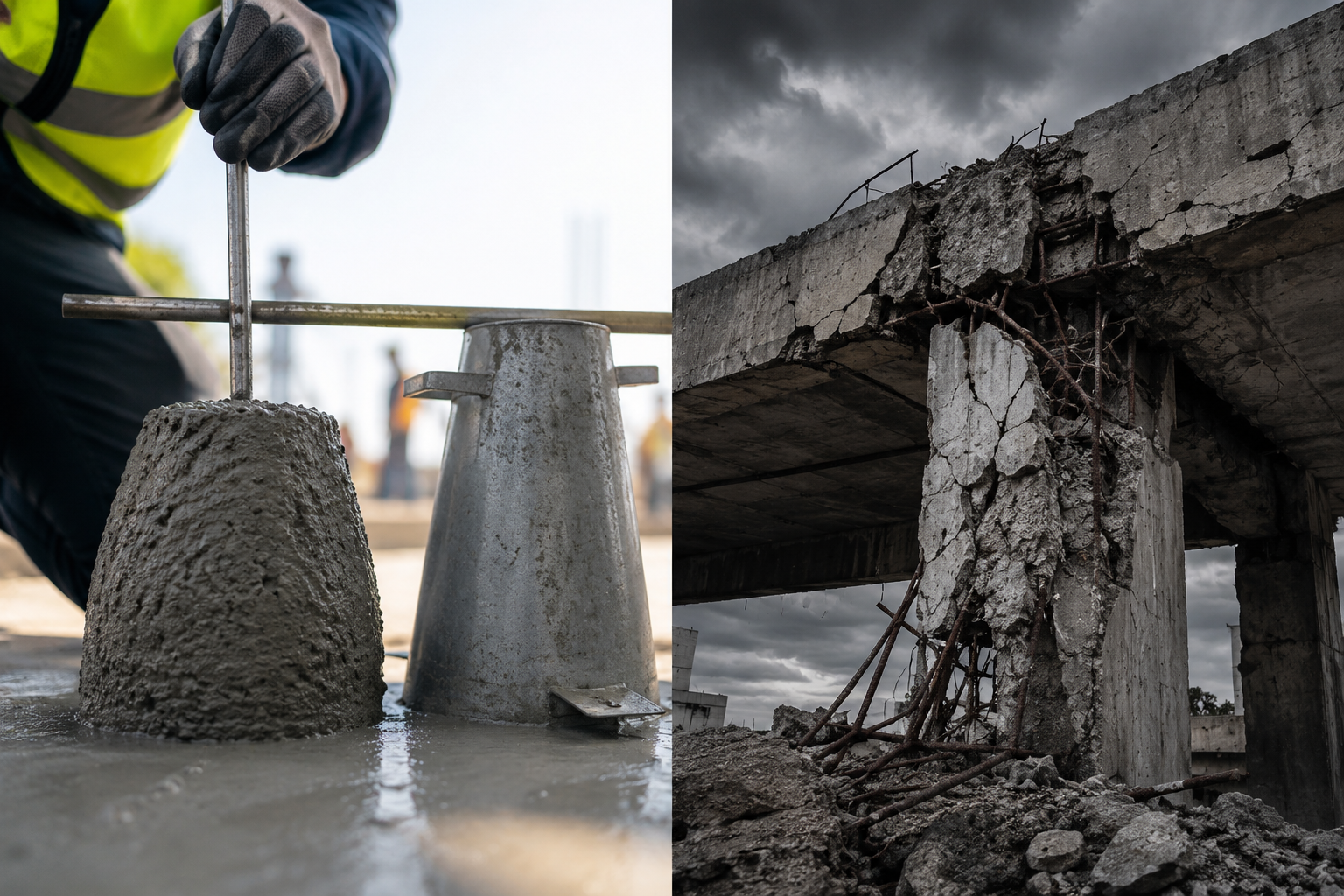
Most conversations about foundation problems start the same way — a homeowner notices a crack, a door starts sticking, or a floor begins to slope. By that point, the damage is already visible and the repair bill is already climbing. What rarely gets discussed is the moment the problem actually started: back on the day the concrete was poured.
Contractors, inspectors, and civil engineers have long understood that fresh concrete behavior is one of the most reliable predictors of how a slab or foundation will hold up years down the road. Yet on many residential and light commercial pours, quality checks are rushed or skipped entirely in the interest of time. That shortcut creates a slow-moving problem — one that foundation repair specialists across the country end up inheriting.
This piece explores the link between what happens at the mixing truck and what happens to a structure a decade later, and why that window of thirty or forty minutes before the pour sets matters far more than most property owners ever realize.
Workability Is Not Just a Convenience Metric
The slump test gets treated, in many field settings, as a formality — something to tick off before the real work begins. But what it actually measures is the water-to-cement ratio at the time of placement, and that ratio has direct consequences for compressive strength, permeability, and long-term durability.
A mix that is too wet — pushed beyond the specified slump because it makes finishing easier — will bleed excessively as water rises to the surface during setting. That bleeding leaves behind a network of capillary channels inside the hardened concrete. Over years of freeze-thaw cycling and moisture exposure, those channels allow water to infiltrate, expand, and slowly weaken the slab from within.
A mix that is too stiff, on the other hand, creates consolidation problems. If the concrete cannot flow properly around rebar or into corners, you end up with honeycombing — pockets of air inside the structure that compromise load distribution from day one. Neither scenario produces the foundation the structural drawings called for, even if the finished surface looks perfectly acceptable to the naked eye.
This is why professionals who take quality seriously treat the slump test not as red tape but as a first line of defense. The few minutes spent running a proper concrete slump test before placement can prevent years of structural drift that no cosmetic repair can fully correct.
What Happens When the Numbers Are Off — And Nobody Catches It
The challenge with concrete quality failures is that they are almost never immediately obvious. A slab poured with the wrong water content does not collapse the next morning. It passes visual inspection. It cures, it hardens, it gets finished on schedule. The problem quietly develops inside the material over months and years.
Expansive clay soils — common throughout Oklahoma and much of the central and southern United States — apply upward and lateral pressure on slabs as they absorb moisture. A foundation poured to correct specifications can resist a significant amount of that pressure. One poured with excessive water and reduced compressive strength begins to yield earlier under the same load. The differential movement that follows is what causes the classic signs homeowners eventually notice: wall cracks that follow mortar joints, doors that bind in their frames, interior floors that feel uneven underfoot.
By the time those symptoms appear, the underlying cause is rarely traceable. Nobody pulls out the poor records from eight years ago. The foundation repair contractor arrives, assesses the movement, installs piers or performs a lifting procedure, and stabilizes what is there. It is effective work — necessary work — but it would have been less necessary if the mix had been tested properly before it left the chute.
The Testing Sequence That Actually Protects a Project
For contractors and project managers who want to close this gap, the process is straightforward — it just requires discipline at several specific moments.
First, test the fresh mix before placement. Slump, air content, and unit weight should all be checked from the first truck and periodically through the pour if conditions change. Temperature matters too; a mix that meets spec at the plant can arrive at a different work-ability if the haul takes longer than expected on a hot day.
Second, make and cure test cylinders properly. A cylinder that dries out on the back of a pickup truck before reaching the lab is not going to give you a meaningful compressive strength result. Curing conditions in the field need to match what the mix design assumed, and concrete test cylinders need to be handled and stored according to ASTM C31 from the moment they are filled.
Third, document everything. If the mix was adjusted at the site — water added, admixtures used — that should be recorded along with the adjusted slump reading. A lot of quality problems are traceable when records exist and invisible when they do not.
Finally, take seriously any result that falls outside the specified range. A slump reading two inches above the upper limit is not something to wave through because the driver is in a hurry. It is information, and the decision to proceed with that mix should be a conscious one made by someone with the authority and the understanding of what the deviation means for the finished product.
Why Foundation Repair Specialists See Patterns Contractors Never Do
There is an interesting asymmetry in the construction industry. The team that pours a foundation rarely sees what happens to it fifteen years later. The team that repairs it has no visibility into what happened the day it was poured. The two halves of the picture almost never come together.
Foundation repair professionals — particularly those working in geologically challenging areas with reactive soils — develop a keen intuition about which structures are failing for reasons beyond soil movement alone. When a foundation is showing distress at a level disproportionate to the soil conditions around it, or when the concrete itself is visibly porous, chalky, or delaminating on exposed sections, it raises the question of whether the material ever had the strength it was supposed to have.
That kind of forensic thinking is becoming more common as the industry matures. Some engineering firms now include core sampling and concrete strength assessment as part of a comprehensive foundation evaluation, rather than assuming the as-built structure meets the design specification. It adds cost, but it also answers questions that pure visual inspection cannot.
A Small Investment That Changes the Trajectory
For anyone involved in placing concrete — whether on a residential foundation, a commercial slab, or an infrastructure project — the equipment and time required to test fresh mixes properly is not a significant budget line. A reliable slump cone and tamping rod, a set of properly calibrated cylinders, and a few minutes of attention at the pour site represent a genuinely small investment relative to the cost of a foundation repair project.
That calculus becomes even clearer when you consider the secondary costs of foundation failure: disruption to occupants, damage to finishes and landscaping during repair, loss of property value during the period of visible distress, and the stress that comes with discovering a structural problem years after moving in.
The concrete was always going to do what the mix told it to do. The only question is whether anyone checked the mix before it was too late to do anything about it.
Final Thought
Good foundations are not built by accident. They are the result of decisions made at every stage of the construction process, and one of the most consequential decisions happens in the thirty minutes between the concrete truck pulling up and the pour beginning. Testing that mix — really testing it, with calibrated equipment and documented results — is not extra caution. It is the baseline standard that protects the structure, the contractor’s reputation, and the person who will eventually live or work inside that building.
The warning signs that show up years later almost always trace back to something that was measurable, and therefore preventable, at the very beginning.


