

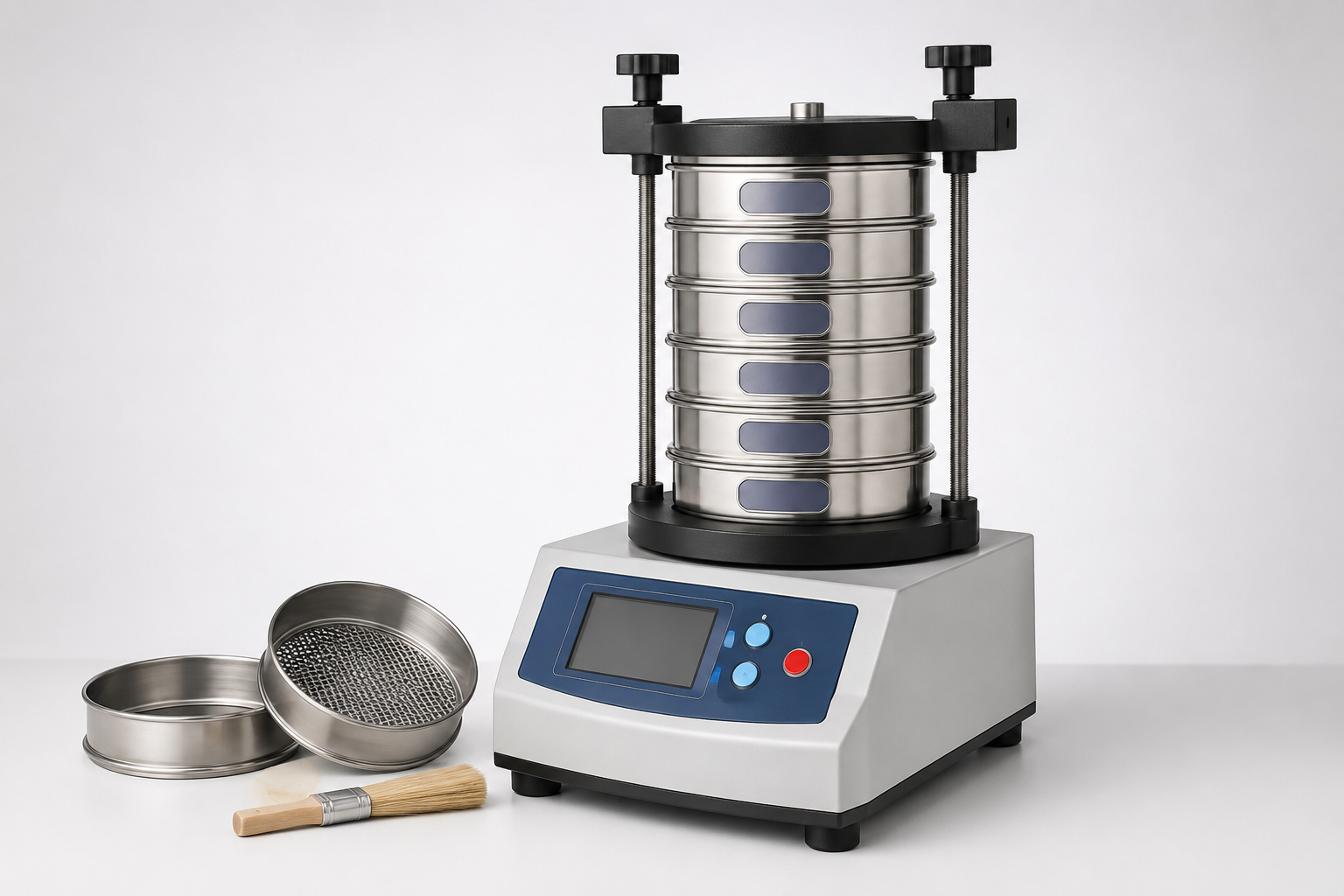
In construction, mining, pharmaceuticals, and industrial manufacturing, material quality starts with accurate particle size analysis. Whether testing aggregates for concrete mixes or analyzing powders in a laboratory, consistency in particle distribution directly affects product performance and compliance with industry standards. One of the most important machines used for this process is the vibratory sieve shaker.
Modern laboratories rely on advanced sieve shakers to deliver repeatable and accurate results while reducing manual effort. Equipment such as the Gilson 8in Vibratory Sieve Shaker has become essential for laboratories handling aggregate testing, soil analysis, cement evaluation, and industrial particle sizing.
What Is a Vibratory Sieve Shaker?
A vibratory sieve shaker is a laboratory machine designed to separate materials based on particle size using vibration and mechanical motion. The machine holds a stack of ASTM test sieves arranged from larger openings at the top to finer meshes at the bottom. When vibration begins, particles move through the sieve stack until they are retained on the appropriate mesh size.
This testing method is commonly used in:
- Construction material testing
- Aggregate analysis
- Cement and concrete quality control
- Mining and mineral processing
- Food and pharmaceutical production
- Soil and environmental testing
Unlike manual sieving, mechanical vibration provides more consistent motion, helping laboratories achieve accurate and repeatable results. According to Certified MTP’s sieving equipment resources, modern sieve shakers are designed to improve testing precision while supporting ASTM and ISO compliance requirements.
How Vibratory Sieve Shakers Work
The working principle behind a vibratory sieve shaker is relatively straightforward but highly effective. A motor or electromagnetic drive creates controlled vibrations that move material across the sieve surface. These movements help particles find openings that match their size.
Advanced systems use multi-directional motion, combining:
- Vertical vibration
- Horizontal circular movement
- Tapping or pulsation
- Electromagnetic agitation
This combination prevents material buildup and improves separation efficiency, especially when testing fine powders or moisture-sensitive materials.
Machines such as the WS Tyler Ro-Tap E Sieve Shaker utilize electromagnetic vibration systems to maintain constant amplitude and reliable testing conditions for both coarse and fine materials.
Why Particle Size Analysis Matters
Particle size distribution plays a major role in determining how materials behave during construction and manufacturing processes. In concrete production, improper aggregate grading can negatively affect:
- Workability
- Strength development
- Durability
- Water demand
- Compaction efficiency
Similarly, industries such as pharmaceuticals and food manufacturing depend on accurate particle sizing to maintain product consistency and processing performance.
Laboratories performing aggregate testing equipment procedures use sieve shakers to ensure materials meet project specifications and regulatory standards.
Key Components of a Vibratory Sieve Shaker
Although models vary depending on application requirements, most vibratory sieve shakers include several core components.
Sieve Stack
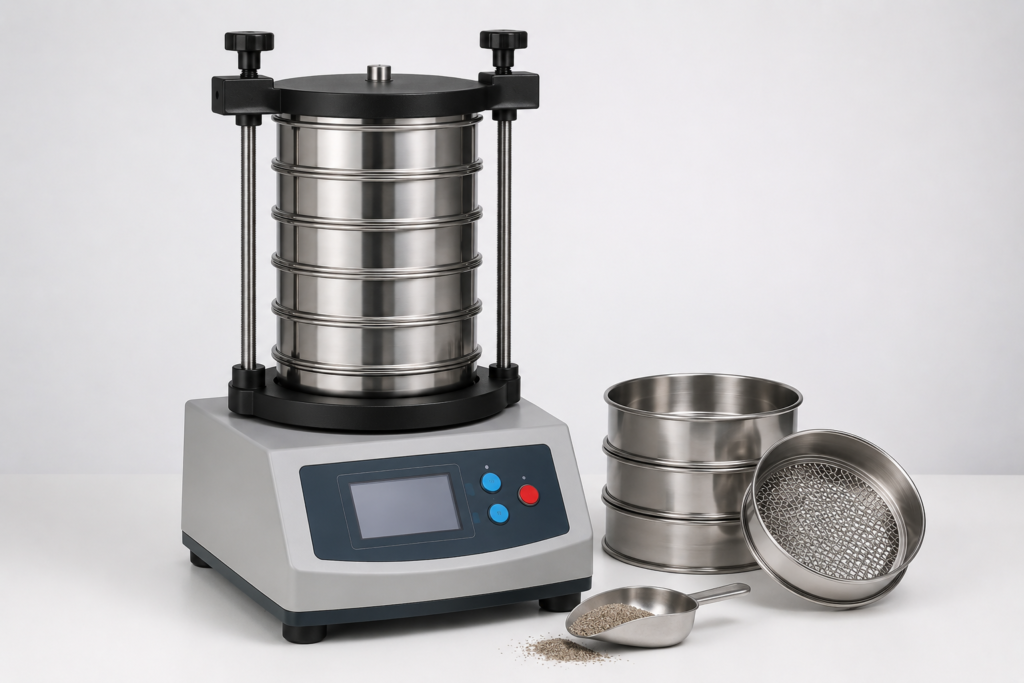
The sieve stack consists of multiple ASTM-compliant test sieves placed in descending mesh size order. These sieves separate particles into different fractions for analysis.
Drive System
The drive mechanism generates vibration and motion. Depending on the model, this may include:
- Electromagnetic drives
- Mechanical motors
- Tapping systems
- Circular oscillation systems
Electromagnetic systems are particularly effective for fine materials because they provide controlled, uniform motion.
Clamping Mechanism
A secure clamping system holds the sieve stack firmly during testing to prevent movement and maintain accuracy.
Digital Controls
Modern sieve shakers often include programmable timers, vibration controls, and testing profiles that improve repeatability between tests.
Benefits of Using Vibratory Sieve Shakers
Improved Accuracy
Mechanical vibration creates consistent movement that manual sieving cannot match. This consistency improves the reliability of particle size analysis and minimizes operator error.
Faster Testing
Vibratory systems significantly reduce testing time compared to hand sieving. High-frequency vibration allows materials to pass through sieves more efficiently, improving laboratory productivity.
Better Repeatability
Repeatability is critical in quality control laboratories. Advanced sieve shakers allow technicians to store testing parameters and reproduce identical conditions across multiple tests.
Reduced Labor Fatigue
Manual sieve analysis can be physically demanding and time-consuming. Automated systems reduce repetitive work and improve operator efficiency.
Versatility Across Industries
Modern sieve shakers can process:
- Aggregates
- Sand
- Cement
- Soil
- Chemicals
- Powders
- Granular materials
This versatility makes them valuable across a wide range of testing environments.
Common Applications in Construction and Material Testing
Aggregate Testing
Aggregate gradation directly affects concrete and asphalt performance. Laboratories use vibratory sieve shakers to determine whether aggregates meet ASTM specifications.
Soil Classification
Geotechnical laboratories analyze soil particle distribution to assess compaction, drainage, and engineering suitability.
Cement and Powder Analysis
Fine cement powders require accurate particle separation for quality assurance and performance evaluation.
Asphalt Material Testing
Sieve analysis helps evaluate asphalt mixtures and ensures proper aggregate blending for pavement durability.
Mining and Mineral Processing
Mining operations use sieve shakers to separate and classify ores, minerals, and crushed materials during processing.
Wet Sieving vs. Dry Sieving
Many laboratories perform both dry and wet sieving depending on the material being tested.
Dry Sieving
Dry sieving works well for free-flowing materials that do not clump or stick together. This method is common in aggregate and soil testing.
Wet Sieving
Wet sieving is used for materials containing very fine particles that may agglomerate during dry testing. Water helps separate particles and improve accuracy.
Some advanced machines support both testing methods, increasing laboratory flexibility.
Factors to Consider When Choosing a Sieve Shaker
Selecting the right sieve shaker depends on laboratory needs and testing requirements.
Important considerations include:
- Particle size range
- Sample volume
- Testing frequency
- ASTM or ISO compliance
- Noise levels
- Digital control features
- Wet or dry sieving compatibility
Laboratories handling high sample volumes often benefit from programmable models with multiple vibration settings and automated controls.
Maintaining a Vibratory Sieve Shaker
Proper maintenance helps preserve testing accuracy and extend equipment lifespan.
Best practices include:
- Cleaning sieves after each test
- Inspecting mesh for damage
- Checking clamping systems regularly
- Calibrating timers and vibration settings
- Keeping moving components free from debris
Routine inspection helps prevent inaccurate test results caused by worn or damaged equipment.
The Future of Material Testing Equipment
Material testing technology continues to evolve with improved automation, digital controls, and data management capabilities. Modern laboratories increasingly rely on smart testing systems that enhance accuracy while reducing manual intervention.
Advanced sieve shakers now offer features such as:
- Touchscreen interfaces
- Stored testing profiles
- Adjustable vibration amplitude
- Automated timing systems
- Improved energy efficiency
As construction standards and quality expectations continue to rise, reliable particle analysis equipment will remain essential for ensuring material performance and regulatory compliance.
Final Thoughts
Vibratory sieve shakers play a critical role in modern material testing laboratories. By improving particle size analysis accuracy, reducing testing time, and enhancing repeatability, these machines help industries maintain quality standards across a wide range of applications.
From aggregate testing and soil analysis to cement evaluation and industrial powder processing, vibratory sieve shakers provide dependable performance that supports better decision-making and material quality control.
Laboratories using advanced sieving equipment and ASTM test sieves can achieve more accurate and efficient testing while meeting the growing demands of construction, manufacturing, and research industries.


